
Hire Blockchain Developers in Vietnam: 2026 Employer Guide

Vietnam has become one of Asia’s most practical places to hire blockchain engineering talent in 2026 – not because it is cheap, but because it combines a large software workforce, a genuine domestic Web3 ecosystem, and, as of 1 January 2026, a defined legal framework for digital assets.
This guide covers what foreign employers actually need: how big the talent pool is, which non-engineering roles you will also have to hire, what salaries look like, which hiring model fits which situation, the labour law essentials, and how to run a hiring process that does not stall.
Table of contents
- 1 Why do foreign employers hire blockchain developers in Vietnam?
- 2 How large is Vietnam’s blockchain talent pool, really?
- 3 Which non-engineering roles will you also need?
- 4 What do blockchain developer salaries in Vietnam look like?
- 5 Which hiring model should you choose?
- 6 What are the labour law essentials when hiring in Vietnam?
- 7 How do you actually run the hiring process?
- 8 What mistakes do foreign employers make most often?
- 9 How do you keep the engineers you hire?
- 10 What is changing in the market through 2026?
- 11 Where do you start?
- 12 Frequently asked questions
Why do foreign employers hire blockchain developers in Vietnam?
Three reasons stand out, and each is backed by published data rather than sales copy.
| Factor | Data point | Source (year) |
|---|---|---|
| Foreign investor confidence | 56.9% of Japanese companies in Vietnam plan to expand operations in the next 1–2 years — first in ASEAN for the second consecutive year, above the ASEAN average of 46.8% | JETRO, FY2025 Survey on Business Conditions of Japanese-Affiliated Companies Overseas (2025) |
| Grassroots crypto familiarity | Vietnam ranked 4th out of 151 countries | Chainalysis, 2025 Global Crypto Adoption Index (2025) |
| Size of the software workforce | Approx. 560,000 professionals in computer science and IT fields | TopDev, Vietnam IT Market Report 2024–2025 |
| A live local hiring market | 1,029 blockchain job listings from companies operating in Vietnam analysed for 2025 | BlockchainWork, Vietnam Blockchain Job Market Report 2025 (2026) |
| Share of global open-source crypto developers | Vietnam holds 1.4% of the world’s open-source crypto developers, up from 0.4% in 2015 — a 15-place climb to 19th | Electric Capital, Developer Report (data through 2026) |
| Cost structure | Low labour costs cited by 55.2% of Japanese firms as a key attraction of Vietnam; market size and growth potential cited by 68.4% | JETRO, FY2025 Survey (2025) |
| Legal clarity for digital assets | Law on Digital Technology Industry in force from 01/01/2026; Resolution 05/2025/NQ-CP piloting the digital asset market, issued 09/09/2025 | Vietnam Government Portal (2025) |
The less obvious reason: Vietnam has produced Web3 products with global user bases — Sky Mavis (Axie Infinity) and Ninety Eight (Coin98) being the best known. That matters for hiring because it means the local market contains engineers who have shipped and maintained production blockchain systems under real load, not only engineers who have completed tutorials.
One caution to set expectations: the same JETRO survey found that nearly half of Japanese companies in Vietnam have found recruitment harder over the past two years. Vietnam is a strong talent market, not an easy one. Speed and process quality decide who wins candidates.
How large is Vietnam’s blockchain talent pool, really?
Answer first: the general software pool is large, the blockchain-specialised pool is small, and the gap between the two is where your hiring strategy lives.
TopDev’s Vietnam IT Market Report 2024–2025 puts the total IT workforce at roughly 560,000 people, against a forecast annual shortfall of 150,000–200,000 programmers and engineers across 2023–2025. Blockchain sits in the same scarce, specialised bracket as cybersecurity and AI — meaning a smaller candidate set and faster competition for the people in it.
Two independent datasets show where Vietnam actually sits.
Globally. Electric Capital’s Developer Report puts Vietnam at 1.4% of the world’s open-source crypto developers (1.2% of full-time developers), up from 0.4% in 2015 — a climb from 34th to 19th place. Asia as a whole now accounts for 31.3% of open-source crypto developers and 36.8% of new developers, the highest share of any continent. Vietnam is a mid-sized but fast-rising contributor, not a marginal one. Note that this measures public open-source contribution, so it understates engineers working exclusively on closed-source products.
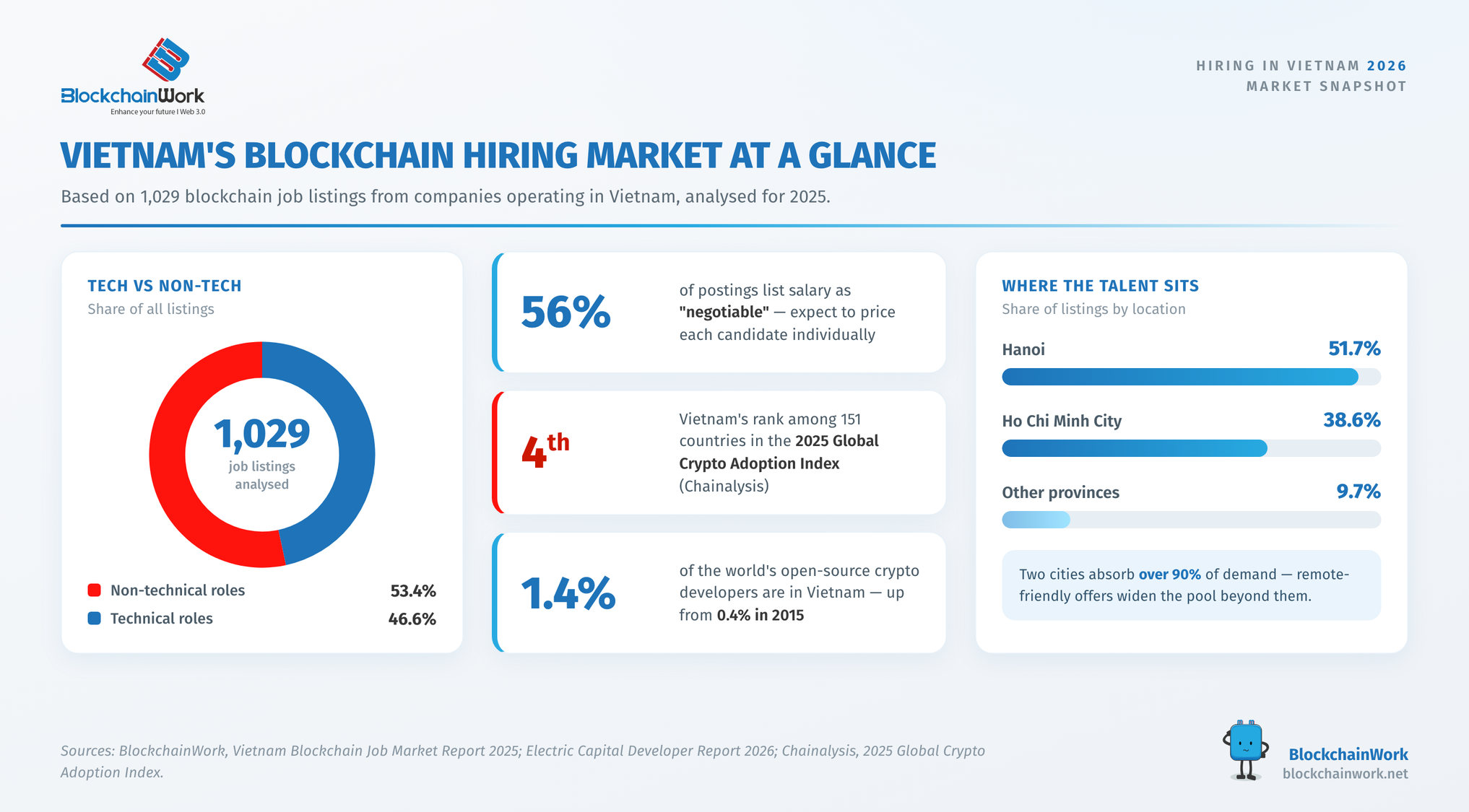
Locally. BlockchainWork’s Vietnam Blockchain Job Market Report 2025, based on 1,029 blockchain job listings from companies operating in Vietnam, shows what those companies are actually hiring for:
| What the 2025 listings show | Figure | Why it matters to you |
|---|---|---|
| Technical vs non-technical split | 46.6% technical / 53.4% non-technical | Your engineering hires are less than half of what a working blockchain team needs |
| Most recruited technical roles | Backend Developer 18.75%, Full-stack Developer 17.08%, Blockchain Developer 11.67% | Conventional backend skills dominate demand — pure smart contract roles are the minority |
| Geographic concentration | Hanoi 51.7%, Ho Chi Minh City 38.6% | Choose your base city deliberately; the two hubs have different company profiles |
| Salary transparency | 56% of postings list salary as negotiable | Published ranges are weak benchmarks here; expect to price candidate by candidate |
Source: BlockchainWork, Vietnam Blockchain Job Market Report 2025 (published 2026).
For scale on the specialist end, research by 23studio using Glassdoor data cited in the same report estimates roughly 26,000 blockchain engineers worldwide against about 440,000 open positions — up to 17 companies chasing each engineer. That global ratio, not the local one, is what you are competing against for senior on-chain talent.
What this means in practice:
- Senior smart contract engineers with 4+ years of on-chain production experience are scarce, and typically already employed by product companies or working with international clients.
- Strong mid-level backend engineers who can be trained onto a chain are plentiful. Many production blockchain roles are 70% conventional backend work — APIs, indexers, node infrastructure, on-chain/off-chain synchronisation — with a chain-specific layer on top.
- Security and audit specialists are the hardest single group to hire, in Vietnam as everywhere else.
Employers who insist on hiring only pre-qualified senior smart contract engineers usually spend months searching. Employers who hire strong backend engineers and invest in a structured ramp-up onto their chain usually fill roles in weeks.
Which non-engineering roles will you also need?
Answer first: most foreign employers budget for engineers and forget that a blockchain product in Vietnam does not ship, launch or stay compliant on engineering alone. The roles below are consistently easier and faster to fill than senior smart contract engineers, and they are where a lot of avoidable friction disappears.
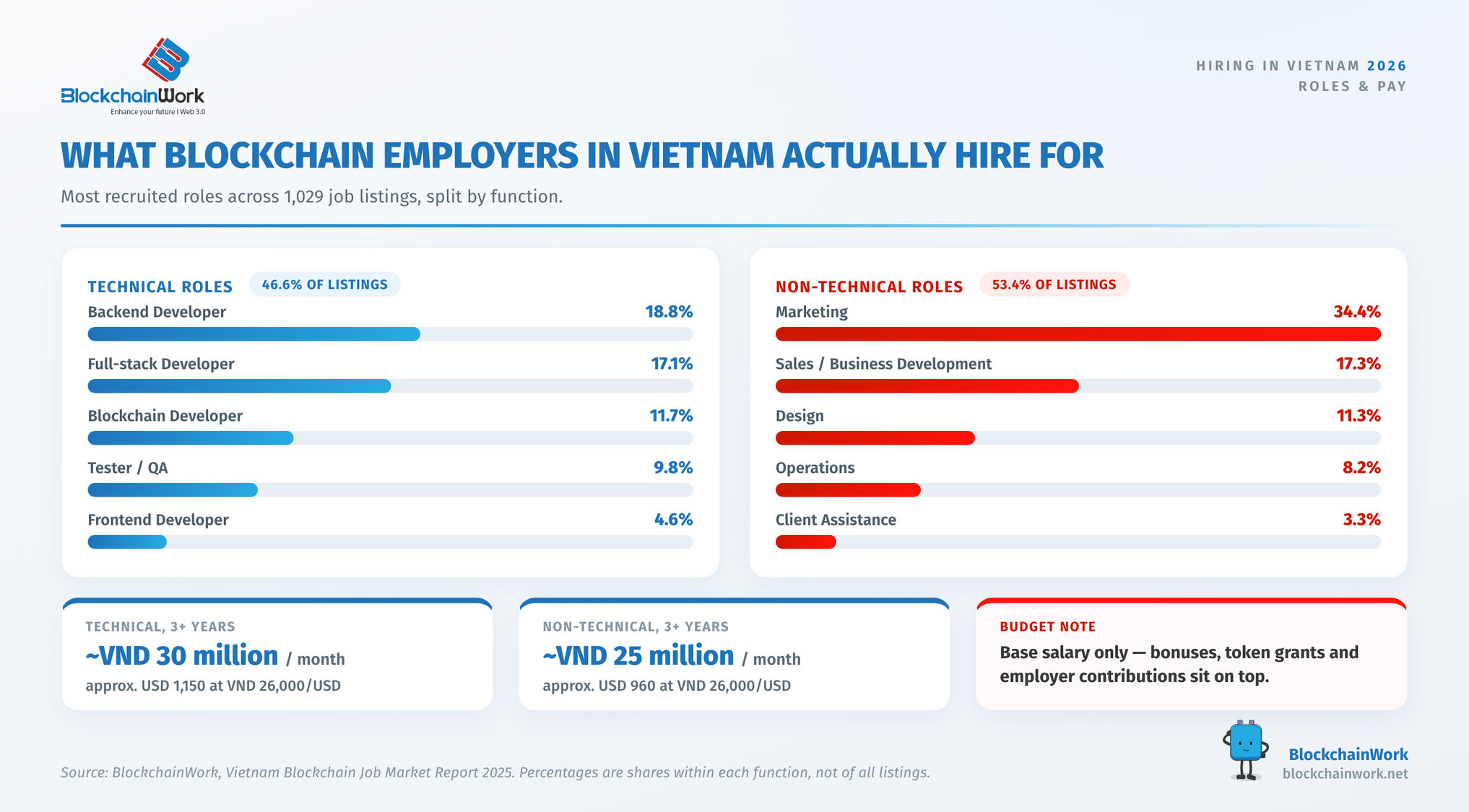
The local market already reflects this. Non-technical roles made up 53.4% of the 1,029 blockchain job listings analysed for 2025, led by marketing (34.4% of non-technical openings), sales (17.3%) and design (11.3%) — evidence that companies in Vietnam are hiring for commercialisation and ecosystem growth, not only for protocol development (BlockchainWork, 2026).
| Role | What it actually does for you | Why hire it locally |
|---|---|---|
| Business Analyst | Turns your requirements into specifications the local team works from; catches misunderstandings before they become sprints | Removes the single largest source of offshore rework: ambiguous requirements crossing a language boundary |
| Project Manager / Delivery Lead | Owns scope, schedule and reporting; runs the interface between your headquarters and the team | Lets your own managers stop working Vietnamese hours |
| QA Engineer | Manual and automated testing, release verification, regression suites | Cheaper and faster to hire than backend engineers, and raises delivery quality immediately |
| UI/UX Designer | Wallet flows, dApp interfaces, onboarding journeys for non-crypto-native users | Vietnam has a deep product design pool from its e-commerce and fintech sectors |
| Community & Support | Runs user communities, handles first-line support, escalates real issues to engineering | Time zone coverage for Asian users, and bilingual support at a fraction of Western cost |
| Marketing & Content (bilingual) | Localised content, documentation, developer relations material in English and Vietnamese | Local writers who understand the product beat outsourced agencies for technical content |
| Legal & Compliance | Tracks the digital asset framework in force from 2026, reviews contracts and IP clauses | Vietnamese regulation is new and moving; a local specialist reads primary sources, not translations |
| HR / Talent Acquisition | Sourcing, offer negotiation, retention, onboarding | Vietnamese hiring norms — probation practice, Tet bonus expectations, counter-offer culture — are learned locally, not from a handbook |
Two practical points on this group. First, hiring one Business Analyst or delivery lead early usually costs less than the rework it prevents, especially in the first six months when your team is still learning your product. Second, non-engineering salaries in Vietnam sit meaningfully below engineering salaries at the same seniority — the ratio is similar to other tech markets, so a support or QA function that is expensive at headquarters is often the easiest part of a team to build here.
If you are running a small squad, the realistic minimum alongside your engineers is one person who owns requirements and communication — call it BA, PM or delivery lead — plus QA. Everything else can wait until the product has users.
What do blockchain developer salaries in Vietnam look like?
TopDev’s reporting puts average developer salaries in Vietnam in the range of USD 1,100–3,000 per month depending on skills and experience (TopDev, 2024), with broader market surveys placing software developers between USD 900 and USD 2,500 per month depending on skill set, location and seniority.
Blockchain-specialised roles sit at the upper end of, and often above, those general ranges, for the same reason as AI and security roles: scarcity. Treat published general-developer figures as a floor for specialised blockchain hires, not as a target.
Blockchain-specific benchmarks from BlockchainWork’s 2025 market data:
| Segment | Average base salary | Note |
|---|---|---|
| Technical, 3+ years’ experience | ~VND 30 million per month | Roughly USD 1,150 at an exchange rate of about VND 26,000/USD |
| Non-technical, 3+ years’ experience | ~VND 25 million per month | The gap to engineering is narrower than in most Western markets |
Source: BlockchainWork, Vietnam Blockchain Job Market Report 2025 (published 2026). Base salary only — excludes bonuses, tokens and employer contributions.
Three further patterns from the same data are worth budgeting around. Golang and Rust roles carry a salary premium, while JavaScript remains the most widely recruited language. Around 56% of postings leave salary negotiable, so market “ranges” are softer than they look. And blockchain companies routinely combine cash with tokens, performance bonuses and long-term incentives rather than using the fixed salary bands common in traditional IT — which means a cash-only offer competes badly even when the number looks strong.
Four factors move an offer more than the job title does:
- Chain and stack specificity. Production experience on the exact chain you use (EVM, Solana, Move-based chains) commands a premium over general blockchain familiarity.
- English proficiency. Engineers who can run a client call unassisted are priced differently from engineers who need a coordinator.
- Location. Ho Chi Minh City and Hanoi carry the highest benchmarks; secondary cities such as Da Nang sit lower.
- Audit and security exposure. Anyone who has been through a serious external audit cycle on a live protocol prices accordingly.
Beyond base salary, budget for the employer-side mandatory contributions (social, health and unemployment insurance) and the statutory 13th-month or Tet bonus practice, which is near-universal in the Vietnamese tech market even where it is contractual rather than legally required. Confirm current contribution rates with a local payroll provider or counsel — they are adjusted periodically.
Which hiring model should you choose?
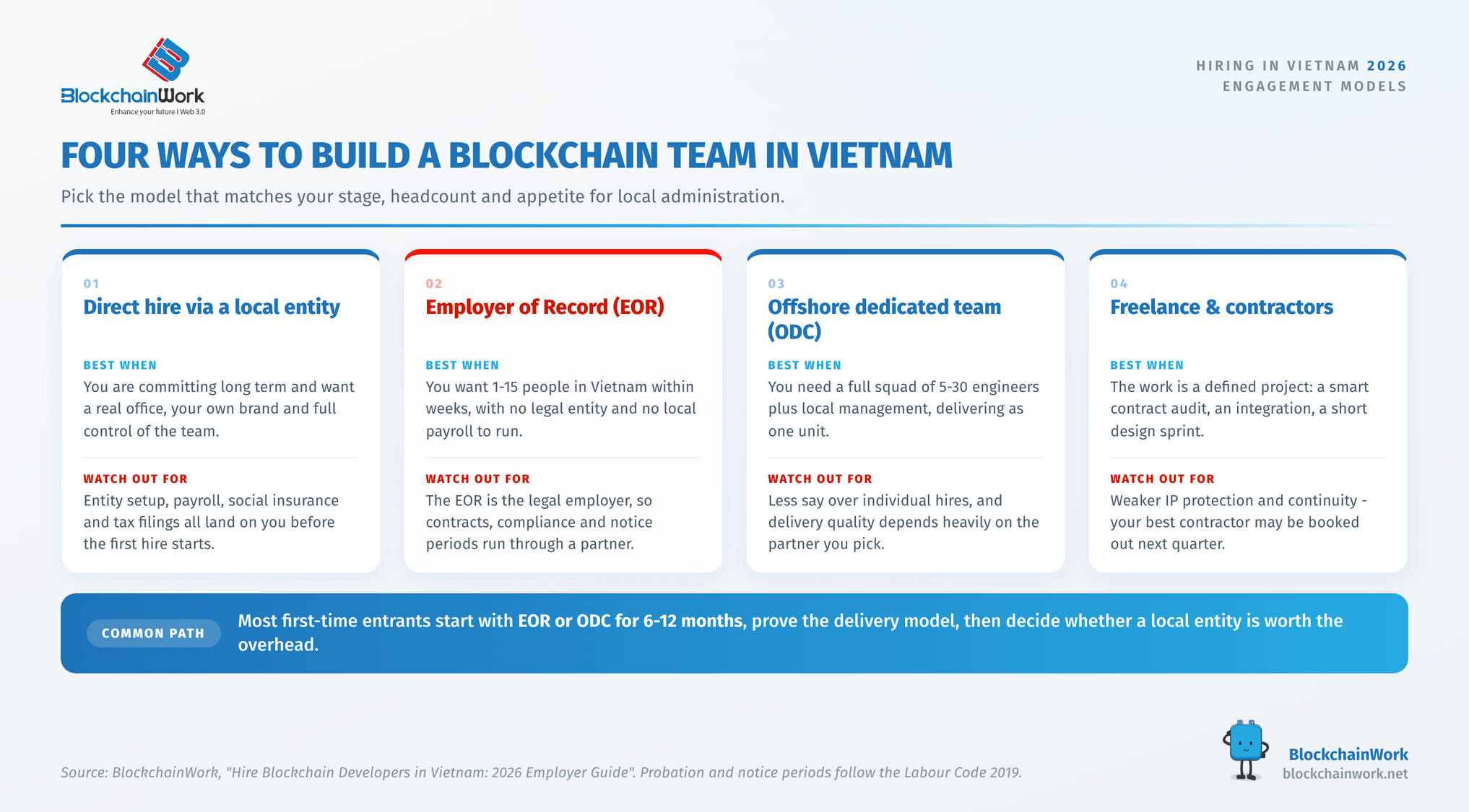
Four models are common for foreign employers. The right one depends on whether you need a legal entity, how long the engagement runs, and how much control you need over the team.
| Model | How it works | Best when | Main constraint |
|---|---|---|---|
| Direct hire via a local entity | You establish a Vietnamese entity and employ staff directly | You are committing to Vietnam long term and building a real office | Entity setup, tax and payroll compliance take time and ongoing overhead |
| EOR (Employer of Record) | A licensed local partner is the legal employer; you direct the day-to-day work | You want 1–15 people without setting up an entity, or you want to test the market first | You do not own the employment relationship directly |
| ODC / dedicated offshore team | A local partner builds and hosts a team that works only on your product | You need a full squad (5–30 people) with local management and facilities | Less direct control over individual hiring decisions |
| Freelance / contractor | Individual contracts for defined scope | Short projects, audits, one-off smart contract work | Weaker IP protection and continuity risk unless contracts are drafted carefully |
For most first-time entrants to the Vietnamese market, the sequence that fails least often is: start with EOR or an ODC arrangement for the first 6–12 months, prove the delivery model works, then decide on an entity once headcount and revenue justify the overhead.
What are the labour law essentials when hiring in Vietnam?
The 2019 Labour Code (No. 45/2019/QH14) governs employment. The provisions foreign employers most often get wrong:
Probation (Article 25). Maximum probation periods are set by role type: 180 days for enterprise manager positions; 60 days for jobs requiring a college-level or higher professional/technical qualification — which covers most engineering roles; 30 days for intermediate-level technical and professional staff; and 6 working days for other jobs. Probation is optional, but where agreed it cannot exceed these caps. Probationary salary must be at least 85% of the agreed full salary.
Written contracts. Employment must be documented. Get the contract language, term type and job description right at signing — retrofitting is harder than it looks.
Intellectual property. This is the single most important clause for a blockchain employer. Ensure your contracts contain explicit assignment of work-product IP, clear confidentiality obligations, and — critically for Web3 teams — clarity on ownership of code, keys, deployment credentials and any tokens or on-chain assets created in the course of work. Do not assume default rules cover it; have the clauses drafted by Vietnamese counsel.
Digital asset compliance from 2026. The Law on Digital Technology Industry, effective 1 January 2026, defines digital assets as assets under the Civil Code expressed as digital data, created, issued, stored, transferred and authenticated by digital technology in an electronic environment. Crypto-assets are the sub-category authenticated using cryptographic or similar technology. Securities, digital forms of legal tender and other financial assets defined under civil and financial law are expressly excluded. Resolution 05/2025/NQ-CP, issued 9 September 2025, pilots a regulated crypto-asset market with requirements on capital, technology and governance for licensed service providers.
If your product touches token issuance, custody or exchange functions with a Vietnamese nexus, this framework affects how you structure the entity and the team, not only how you hire. Get local legal advice early.
How do you actually run the hiring process?
A process that works in Vietnam’s blockchain market, in order:
1. Write a job description that says what the system does. Vietnamese blockchain engineers screen aggressively on technical substance. “Blockchain developer wanted, competitive salary” gets ignored. Name the chain, the stack, the product, the scale, and whether the code is public.
2. Decide your English bar honestly. Requiring near-native English on every role shrinks your pool dramatically. Many teams set a high bar for two or three client-facing roles and a working-proficiency bar for the rest.
3. Keep the process to three steps and two weeks. Screening call, technical assessment, final interview with the hiring manager. Strong candidates in this market hold multiple offers; a four-week process with five rounds loses them to a faster competitor.
4. Make the technical assessment resemble the job. A short, paid, take-home task on a realistic problem — reviewing a contract for vulnerabilities, building a small indexer — predicts performance far better than algorithm puzzles, and candidates respect it more.
5. Present the full package, not just base salary. Bonus practice, insurance, equipment, remote flexibility and learning budget are all decision factors here.
6. Plan onboarding across time zones before the first day. Vietnam is UTC+7. From Japan and Korea the overlap is nearly complete; from Western Europe you have the afternoon; from the US West Coast you have a narrow morning window. Decide which meetings are synchronous and which are written, and write it down before day one.
What mistakes do foreign employers make most often?
- Screening for token experience instead of engineering fundamentals. Someone who has traded actively is not therefore a good protocol engineer.
- Underestimating the counter-offer. Vietnamese tech employers counter aggressively for scarce skills. Assume every accepted offer will be tested.
- Treating Vietnam purely as a cost centre. Teams framed as cheap capacity get cheap-capacity retention. Teams given product ownership stay.
- Leaving IP and key-custody clauses to a generic template. For a blockchain team, ambiguity about who controls deployment keys is an operational risk, not a paperwork issue.
- Hiring one engineer alone. A single remote blockchain engineer with no local peer has a high attrition rate. Hire in pairs where budget allows.
How do you keep the engineers you hire?
Answer first: in a market where the specialised pool is small and every good engineer is contactable, retention is a hiring strategy, not an HR afterthought. The cost of replacing a blockchain engineer six months in — re-running the search, re-onboarding onto your chain, absorbing the delivery gap — routinely exceeds what it would have cost to keep them.
The tenure data explains why. In BlockchainWork’s 2025 survey of the Vietnamese blockchain workforce, 48% of candidates had spent less than one year at each company, and only 13% stayed longer than three years. When asked what makes them move, they named salary (68%), skill development opportunities (66%) and the quality of leadership (45%) — in that order. Compensation opens the conversation; the other two decide whether the hire lasts past the first year.
What actually moves retention with Vietnamese blockchain teams:
Give the team the product, not the tickets. The strongest differentiator reported by engineers moving between offshore arrangements and product companies is ownership. A team that receives fully specified tickets from headquarters and never speaks to a user will lose its best people to a company that offers the opposite. Where possible, hand over a whole surface — a service, a module, a protocol component — with the decisions that come with it.
Budget for learning, publicly. Chains, tooling and audit standards shift fast. An explicit annual budget for conferences, audit training or certification signals that you expect the team to grow rather than to execute a fixed spec. It is also comparatively cheap against salary.
Fix the seniority ladder early. Many offshore teams have no visible path beyond “senior engineer”, and people leave to get a title they cannot get from you. Define what tech lead, staff engineer and engineering manager mean in your organisation before someone asks.
Watch the annual cycle. The Vietnamese tech market has a pronounced post-Tet movement period; resignations cluster in the weeks after the Lunar New Year holiday. Reviews, bonuses and any planned promotions land better before that window than after it.
Do not let a remote team be invisible. Regular visits from headquarters, and bringing team members to your own offices, do more for retention than most benefits line items. Where travel is not viable, a consistent written communication culture — decisions recorded in writing rather than settled in a call the offshore team is not in — is the substitute that works.
Pay attention to the second year. Retention risk is lowest early on, when everything is still new, and rises once the initial learning curve is behind and the engineer is fully marketable in your stack. Plan a scope increase, a title change, or a compensation review to land in that window rather than after a resignation letter does.
What is changing in the market through 2026?
Answer first: three shifts are already visible in the 2025 hiring data, and each one changes how you should plan headcount for the year ahead.
AI is compressing the entry level. Blockchain professionals in Vietnam already use AI tools routinely — 53% for research, 43% for writing code and 35% for data analysis. The practical consequence is that work previously assigned to junior engineers is increasingly absorbed by tooling, and demand is shifting toward candidates with three or more years of experience who can direct that tooling and own outcomes. If your plan assumes a large junior intake to keep costs down, expect it to deliver less than it did two years ago.
Compliance roles are becoming part of the core team. With the Law on Digital Technology Industry in force from 1 January 2026 and a pilot regulated crypto-asset market under Resolution 05/2025/NQ-CP, hiring demand is broadening into legal, compliance and risk functions that used to sit outside blockchain teams entirely. Budget for them at the planning stage rather than reacting after a licensing question lands.
Tax treatment of digital assets is being formalised. A personal income tax of 0.1% on digital asset transaction value is expected to apply from 1 July 2026. This does not change how you pay salaries, but it does affect how token-based compensation is perceived by candidates — worth clarifying in an offer conversation rather than leaving to assumption. This is a description of announced policy, not tax advice; confirm the current position with a Vietnamese tax adviser before structuring anything.
Source for the workforce figures in this section: BlockchainWork, Vietnam Blockchain Job Market Report 2025 (published 2026).
Where do you start?
BlockchainWork is a specialised blockchain recruitment platform with a community of 20,000+ candidates, 12+ university MOUs and 300+ partner companies in Vietnam. Rather than screening a general IT database, employers reach candidates who are already working in or actively moving into blockchain and Web3 roles.
Create an employer account at blockchainwork.net/employer-signup to post roles and reach Vietnamese blockchain talent, or contact our team (contact@blockchainwork.net) to discuss which hiring model fits your situation. For ongoing market data on Vietnam’s blockchain talent, follow Blockchain Insider.
Frequently asked questions
1. Do I need a legal entity in Vietnam to hire blockchain developers there?
No. You can hire through an Employer of Record, engage a dedicated offshore development team via a local partner, or contract individuals directly. A local entity is normally worth the overhead once you are committed to a long-term team of meaningful size.
2. What is the maximum probation period in Vietnam?
Under Article 25 of the 2019 Labour Code: 180 days for enterprise manager roles, 60 days for jobs requiring college-level or higher technical qualifications (most engineering roles), 30 days for intermediate technical and professional staff, and 6 working days for other jobs. Probationary pay must be at least 85% of the agreed salary.
3. How much do blockchain developers cost in Vietnam?
TopDev reports average developer salaries in Vietnam of roughly USD 1,100–3,000 per month depending on skills and experience (2024). For blockchain specifically, BlockchainWork’s 2025 market data puts the average base salary for technical roles with 3+ years’ experience at around VND 30 million per month, and non-technical roles at around VND 25 million. Note that 56% of blockchain postings list salary as negotiable, and packages commonly combine cash with tokens and bonuses, so a single figure rarely describes the real offer.
4. Is English a problem when hiring in Vietnam?
It varies by candidate rather than by market. Engineers from product companies and those with international client exposure generally work comfortably in English. Setting a high English bar on every role, rather than only on client-facing ones, is the most common way employers unnecessarily shrink their candidate pool.
5. How does the 2026 digital asset law affect foreign employers?
The Law on Digital Technology Industry, effective 1 January 2026, provides the first legal definition of digital and crypto-assets in Vietnam, and Resolution 05/2025/NQ-CP pilots a regulated crypto-asset market. For employers building non-financial blockchain products the practical effect is greater certainty; for those offering token issuance, custody or exchange services with a Vietnamese nexus, licensing and governance requirements apply and local legal advice is essential.
6. How long does it take to hire a blockchain engineer in Vietnam?
For mid-level backend engineers who will be ramped onto your chain, typically 3–6 weeks from job posting to signed offer with a tight process. Senior smart contract and security specialists take considerably longer because the pool is small and mostly employed.
***Disclaimer: This content does not constitute investment advice, investment strategy recommendations, or sponsored advertising. Please refer to our Disclaimer and use the information at your own discretion.
Sources
- BlockchainWork, Vietnam Blockchain Job Market Report 2025 — Outlook for 2026 (2026) — https://insider.blockchainwork.net/blockchainwork-releases-vietnam-blockchain-job-market-report-2025-outlook-for-2026
- Electric Capital, Developer Report — Geography (data through 2026) — https://www.developerreport.com/geography
- JETRO, FY2025 Survey on Business Conditions of Japanese-Affiliated Companies Overseas (Global Edition) (2025) — https://www.jetro.go.jp/en/news/releases/2025/04461099867183d4.html
- The Investor, Japan firms in Vietnam most willing in Southeast Asia to expand operations: JETRO survey (2025) — https://theinvestor.vn/japan-firms-in-vietnam-most-willing-in-southeast-asia-to-expand-operations-jetro-survey-d18290.html
- Chainalysis, 2025 Global Crypto Adoption Index (2025) — https://www.chainalysis.com/blog/2025-global-crypto-adoption-index/
- TopDev, Vietnam IT Market Report 2024–2025 — https://topdev.vn/page/vietnam-it-market-reports
- Labour Code No. 45/2019/QH14, Article 25 (probation) — https://www.vietnam-legal.com/en/work-in-vietnam/labor-code-no-452019qh14/
- Vietnam Government Portal, Full text of Resolution 05/2025/NQ-CP on piloting the crypto-asset market in Vietnam (2025) — https://xaydungchinhsach.chinhphu.vn/toan-van-nghi-quyet-so-5-2025-nq-cp-ve-trien-khai-thi-diem-thi-truong-tai-san-ma-hoa-tai-viet-nam-119250909184045221.htm
- Regulations on digital assets effective from 01/01/2026 — https://asemconnectvietnam.gov.vn/default.aspx?ID1=1&ZID1=29&ID8=146153
BlockchainWork – Vietnam’s leading blockchain talent community, connecting passionate candidates with pioneering companies in blockchain and Web3. With 20,000+ registered candidates, 12+ educational institution MOUs and 300+ hiring companies, BlockchainWork is the specialized platform for blockchain careers – from Vietnam to global opportunities.
Partnership inquiries: contact@blockchainwork.net
Learn more: https://blockchainwork.net/
Employers – connect with top talent: https://blockchainwork.net/employer-signup
Candidates – find your next opportunity: https://blockchainwork.net/candidate-signup
- BlockchainWork releases Vietnam Blockchain Job Market Report 2025 – Outlook for 2026
- Singapore Management University (SMU) visits BlockchainWork: expanding blockchain talent collaboration across ASEAN
- BlockchainWork and Open Campus join forces to strengthen the Web3 workforce in Vietnam
- Vietnam RWA Summit 2026: refining institutions for crypto assets
- WebX 2026 Tokyo: when Japan places Web3 at the center of national strategy
- BlockchainWork closes Seed 2 at 142,000 USD from Japanese investors: Three strategic priorities for the next growth phase

Pros and Cons of Social Media Recruitment
Using social media in recruitment is an extremely popular form in today’s era. When social networks can be applied in many fields, including recruitment. Using social networks as a recruitment tool brings many significant benefits such as saving…

Niched Job Board vs SNS: Save Hours with BlockchainWork for Blockchain Talent
In the fast-evolving world of blockchain technology, finding the right talent can be a daunting task. With the increasing demand for skilled professionals in this niche sector, employers are often faced with the challenge of sifting through countless…

Top 10 Blockchain Outsourcing Companies in Vietnam
Blockchain technology has revolutionized industries globally, and Vietnam has emerged as a top destination for blockchain outsourcing. Known for its skilled tech workforce, competitive pricing, and thriving startup culture, Vietnam is home to companies excelling in blockchain solutions…

Hiring Blockchain Talent in Vietnam: A Guide for best hire
As the world of blockchain and decentralized technology expands, businesses globally are on the hunt for skilled professionals who can bring blockchain-based solutions to life. With its dynamic workforce and a fast-growing tech industry, Vietnam is emerging as…




Blockchain - Web3 jobs


Business Development (BD Core) - Blockchain/Crypto - (Hybrid TP.HCM - Remote)


