
Vietnam Blockchain Developer Salary 2026: Real Benchmarks

Answer first: a blockchain engineer with three or more years of experience in Vietnam earns a base salary of roughly VND 30 million per month — about USD 1,150 at an exchange rate near VND 26,000/USD (BlockchainWork, Vietnam Blockchain Job Market Report 2025, published 2026). That is a fraction of the USD 175,000 average base salary a Solidity developer earns in the United States (DeFinitive, Web3 Salary Benchmarks, updated April 2026). The BlockchainWork and DeFinitive salary figures in this article are base salary (gross), before allowances, performance bonuses, the 13th-month payment and token grants.
The gap is real, but the headline number is the least useful part of it. In a market where 56% of blockchain job postings list salary as negotiable, where employer contributions add over a fifth on top of base pay, and where token grants routinely sit alongside cash, budgeting from a single figure is how hiring plans go wrong.
This piece sets out what the published data actually says, what an engineer costs you fully loaded, and which factors move an offer more than the job title does.
Table of contents
- 1 What do blockchain developers actually earn in Vietnam in 2026?
- 2 How does Vietnam compare with global Web3 salary benchmarks?
- 3 What does a Vietnamese blockchain engineer actually cost an employer?
- 4 Why is a single salary number misleading in this market?
- 5 What does the salary data say about retention?
- 6 What BlockchainWork recommends to employers building a developer team in Vietnam
- 7 How should you use these benchmarks?
- 8 Frequently asked questions
What do blockchain developers actually earn in Vietnam in 2026?
Answer first: blockchain-specific published data in Vietnam is thin, so the honest approach is to anchor on BlockchainWork’s dataset built from blockchain listings, then use general IT developer survey data only as context for the seniority ladder.
BlockchainWork analysed 1,029 blockchain job listings from companies operating in Vietnam for its Vietnam Blockchain Job Market Report 2025. The blockchain-specific benchmarks:
| Segment | Average base salary | Note |
|---|---|---|
| Technical roles, 3+ years’ experience | ~VND 30 million/month (~USD 1,150) | Base only — excludes bonuses, tokens and employer contributions |
| Non-technical roles, 3+ years’ experience | ~VND 25 million/month (~USD 960) | About VND 5 million below technical roles at the same experience level |
Both figures are gross base salary per month; allowances, bonuses, the 13th-month payment and token grants come on top. Source: BlockchainWork, Vietnam Blockchain Job Market Report 2025 (published 2026). USD conversions rounded at VND 26,000/USD (Vietcombank selling rate VND 25,890/USD on 5 November 2026).
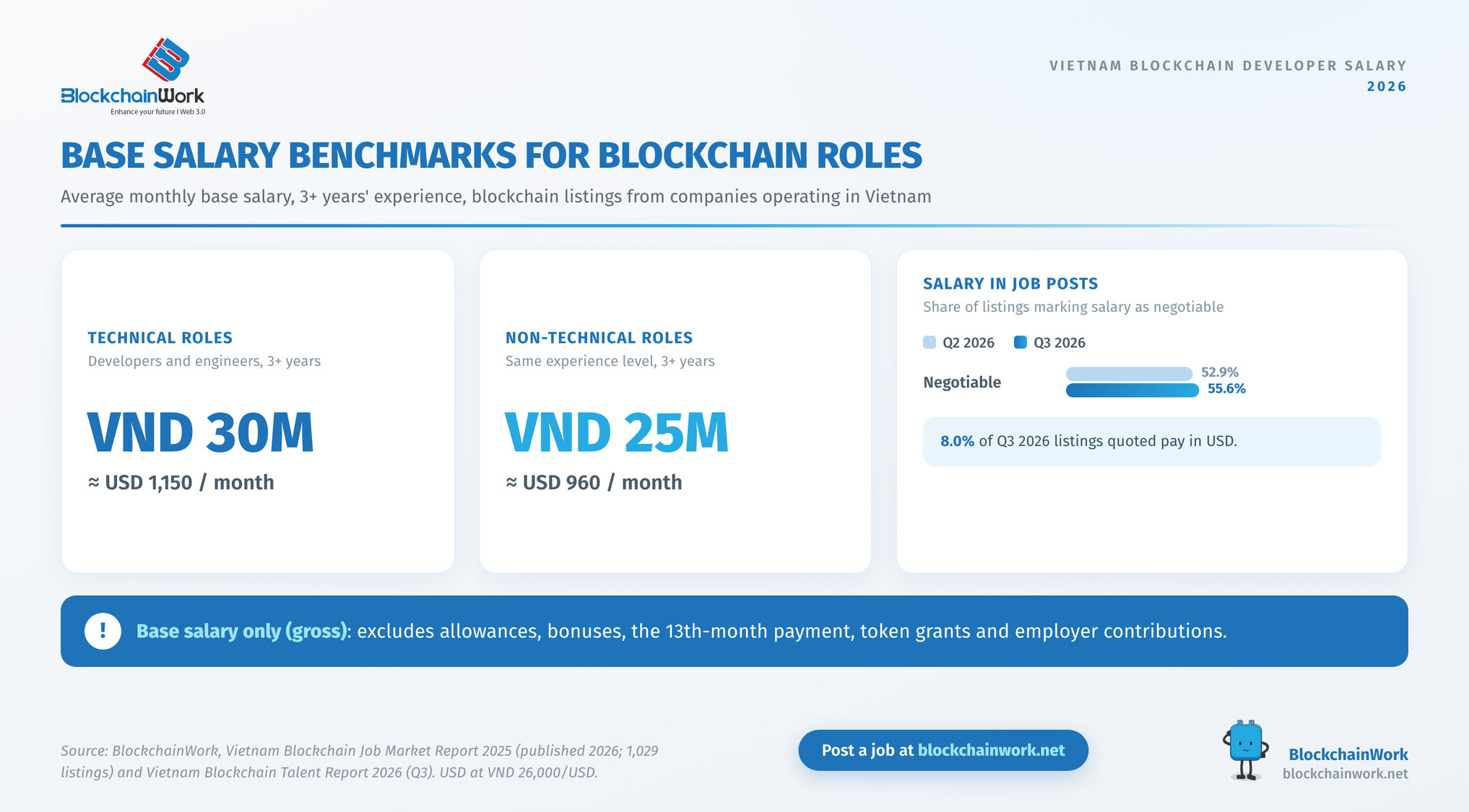
The same report finds Golang and Rust associated with higher salary ranges, JavaScript the most widely recruited language, and about 56% of postings listing salary as negotiable.
The report does not break out blockchain salaries below three years’ experience. For that part of the ladder, the closest reference is the general IT developer market in Vietnam — not blockchain-specific data. Median monthly salaries from ITviec’s IT Salary & Recruitment Market Report 2025-2026 (survey of 1,839 respondents, 2025) for the two role families that dominate blockchain hiring:
| General IT developers (not blockchain-specific) | Under 1 yr | 1–2 yrs | 3–4 yrs | 5–8 yrs | 8+ yrs |
|---|---|---|---|---|---|
| Back-end developer | VND 12.4M | VND 25.35M | VND 30.1M | VND 39.9M | VND 54.9M |
| Full-stack developer | VND 10.1M | VND 20.35M | VND 34.5M | VND 41.8M | VND 44.8M |
Median monthly figures in VND for the Vietnamese IT market as a whole.
Why those two rows and not “blockchain developer”? Because that is what blockchain teams in Vietnam are actually hiring. Within the technical roles in the 1,029 listings, Backend Developer accounted for 18.75% and Full-stack Developer 17.08%, while Blockchain Developer proper accounted for 11.67% (BlockchainWork, 2026). Shares are within the technical group, not of all listings.
Read together, the two datasets are consistent: the VND 30 million blockchain benchmark for 3+ years sits almost exactly on the general IT back-end median for 3–4 years of experience (VND 30.1 million). The blockchain premium in Vietnam shows up less in the base salary line than in the variable components and in how quickly scarce candidates escalate their asking price.
How does Vietnam compare with global Web3 salary benchmarks?
Answer first: Vietnam sits at the lower end of the Southeast Asian band, and the distance to US and Western European benchmarks is roughly an order of magnitude on base salary.
DeFinitive’s Web3 Salary Benchmarks, updated April 2026 and based on 200+ placements across 47 countries plus job-posting data from 270+ Web3 companies, gives the international picture:
| Role | Base salary (USD/yr) | Range |
|---|---|---|
| Solidity developer | 175,000 (US average) | 120,000–250,000 |
| Rust developer | 185,000 (average) | 130,000–300,000 |
| Smart contract auditor | 195,000 (median) | 100,000–350,000+ |
| Protocol engineer | 200,000 (median) | 160,000–320,000 |
| ZK engineer | 230,000 (median) | 180,000–350,000 |
| Region | Developer base range (USD/yr) | Versus US Tier 1 |
|---|---|---|
| US Tier 1 (SF/NYC) | 140,000–260,000 | 100% |
| Western Europe | 90,000–200,000 | 65–80% |
| Southeast Asia | 45,000–140,000 | 35–55% |
| US Tier 2 (remote/other) | 120,000–240,000 | 85–95% |
Source: DeFinitive, Web3 Salary Benchmarks (updated April 2026). The report notes that fully remote roles typically pay US Tier 2 rates regardless of location.
A Vietnamese engineer at the VND 30 million benchmark is on roughly USD 13,800 per year in base salary — below even the floor of the Southeast Asia band in that dataset (USD 45,000–140,000, with Bangkok, Jakarta and Manila listed as the key markets), which is built from placements with international Web3 employers.
Two points of interpretation matter here, and skipping them produces bad budgets.
First, the same report notes that 75% of Web3 roles are fully remote and that token grants typically add 15–40% on top of base compensation. Vietnamese engineers with strong English and a public track record are directly reachable by those remote roles. The local benchmark describes what local employers pay, not the ceiling on what your candidate could earn elsewhere.
Second, low base salary is not the same as low total cost. The next section is where most first-time budgets break.
What does a Vietnamese blockchain engineer actually cost an employer?
Answer first: add roughly 21.5% in mandatory insurance contributions, a 2% trade union fee and an effective extra month of pay for the near-universal Tet bonus practice, and a VND 30 million base becomes about VND 39.5 million per month all in.
Vietnam’s 2026 contribution structure, under the 2024 Social Insurance Law in force from 2026:
| Item | Employer | Employee |
|---|---|---|
| Social insurance | 17.5% | 8% |
| Health insurance | 3% | 1.5% |
| Unemployment insurance | 1% | 1% |
| Total | 21.5% | 10.5% |
Contribution ceilings for 2026: social and health insurance are capped at a contribution base of VND 50,600,000 per month from 1 July 2026 (VND 46,800,000 before that date); unemployment insurance is capped at VND 106,200,000 per month in Region I (20× the regional minimum wage of VND 5,310,000). For foreign employees, unemployment insurance does not apply, giving an employer rate of 20.5%. Source: Indochina Link, Vietnam Social Insurance 2026 (2026).
Separate from the three insurance lines, the employer also pays a trade union fee of 2% of the payroll used as the basis for compulsory social insurance. It is an employer-only cost, paid from the company’s own funds and booked as a business expense, not deducted from the employee’s salary. The Trade Union Law places it on every enterprise that employs workers, so it is owed whether or not a grassroots trade union has been set up at the company. Because it is calculated on the social insurance payroll, the VND 50,600,000 ceiling effectively limits it as well. Sources: Trade Union Law No. 50/2024/QH15, Article 29(1)(b), as amended by Law No. 97/2025/QH15, in force from 1 July 2025; Decree No. 105/2026/ND-CP of 31 March 2026 on trade union finance, Articles 2 and 5, in force from 16 May 2026.
Worked example for one mid-level engineer at the blockchain benchmark:
| Line item | VND/month | USD/month |
|---|---|---|
| Base salary | 30,000,000 | ~1,150 |
| Employer insurance contributions (21.5%) | 6,450,000 | ~250 |
| Trade union fee (2%, employer only) | 600,000 | ~23 |
| 13th-month / Tet bonus, amortised | 2,500,000 | ~96 |
| Fully loaded | 39,550,000 | ~1,520 |
USD conversions rounded at VND 26,000/USD (Vietcombank selling rate VND 25,890/USD on 5 November 2026). Excludes equipment, workspace, and any token or performance component.
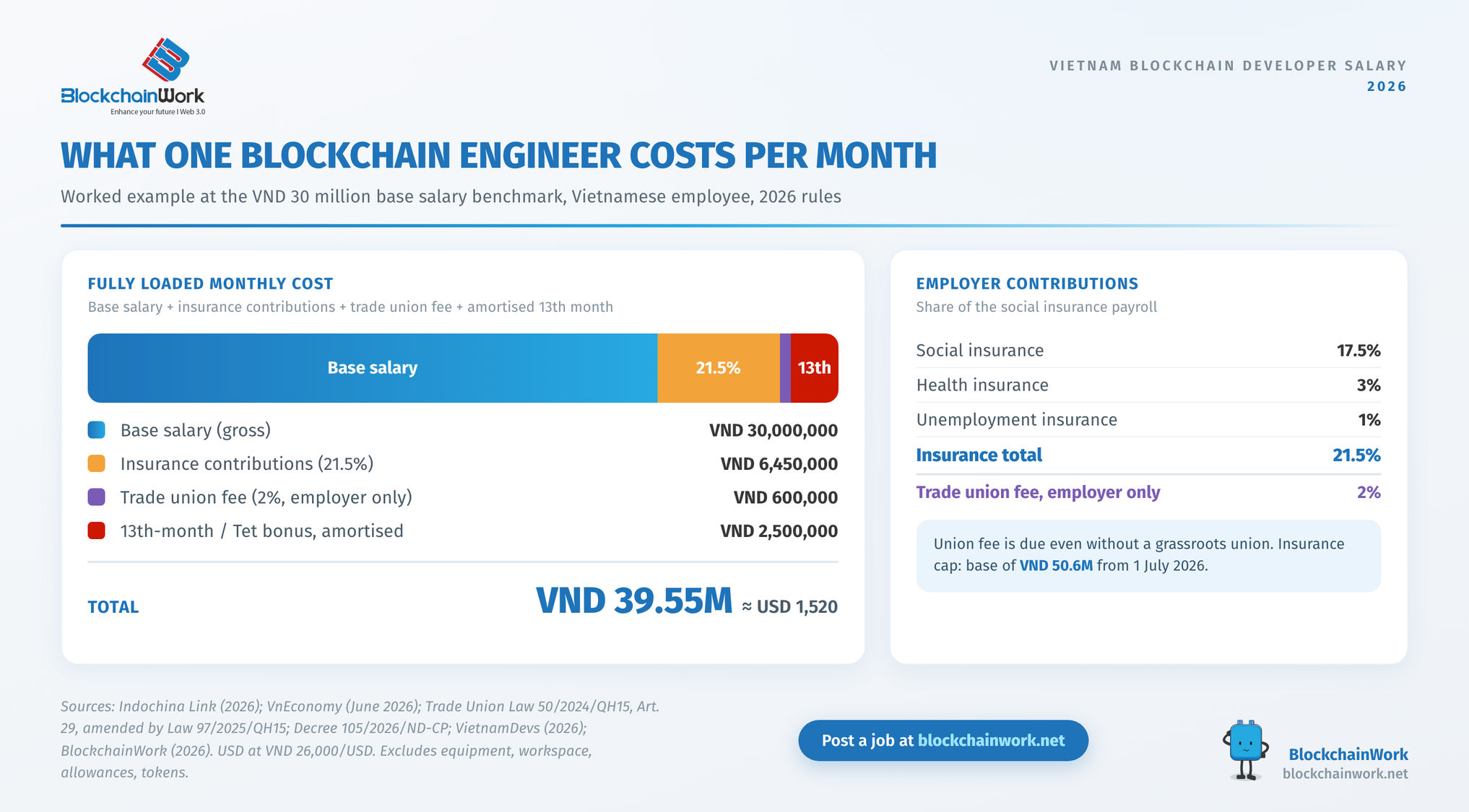
The 13th-month payment is contractual rather than statutory, but guides for international recruiters describe it as effectively mandatory in the Vietnamese tech market (VietnamDevs, 2026), and candidates price it into their expectations. Budgeting twelve months of salary and discovering a thirteenth in January is a common and avoidable surprise. Contribution rates and ceilings are adjusted periodically — confirm the current position with a local payroll provider or counsel before you finalise a plan. For how this cost line looks from the side of a Japanese employer planning a Vietnam team, see Why Japanese Firms Hire Vietnamese Engineers (2026 Data).
Why is a single salary number misleading in this market?
Answer first: because most Vietnamese blockchain employers do not publish one. In the 1,029 listings analysed for 2025, 56% listed salary as negotiable (BlockchainWork, 2026). The pattern has held into 2026: in Q3 2026, 55.6% of listings on BlockchainWork’s job board marked salary as negotiable, up from 52.9% in Q2, and 8.0% quoted pay in USD (BlockchainWork, Vietnam Blockchain Talent Report 2026). Published “ranges” in this market are far softer than they look, and pricing happens candidate by candidate.
Four things widen or narrow an offer more than the job title does.
Chain and stack specificity. Production experience on the exact chain you run — EVM, Solana, a Move-based chain — commands a premium over general blockchain familiarity. Within language demand, JavaScript is the most widely recruited across Vietnamese blockchain listings, while Golang and Rust roles carry a salary premium (BlockchainWork, 2026).
English proficiency and remote exposure. Working English decides whether a candidate can join an international team at all. Market guides for international recruiters put the premium for remote roles with foreign companies at 15–25% over equivalent local roles (VietnamDevs, Vietnam Software Developer Salaries: 2026 Guide for International Recruiters, 2026).
Location. Blockchain hiring in Vietnam concentrates in two cities — Hanoi at 51.7% of listings and Ho Chi Minh City at 38.6% (BlockchainWork, 2026) — and those two carry the highest benchmarks. Da Nang and secondary cities sit lower.
Audit and security exposure. Anyone who has been through a real external audit cycle on a live protocol prices separately. Internationally, smart contract auditors sit at a median base of USD 195,000, with a range of USD 100,000–350,000+ (DeFinitive, April 2026).
One more variable that is easy to miss: composition. Blockchain companies routinely combine cash with tokens, performance bonuses and long-term incentives rather than using the fixed salary bands common in traditional IT. A cash-only offer competes badly against a package even when the cash number looks stronger.
What does the salary data say about retention?
Answer first: paying at benchmark buys you a hire, not tenure. In BlockchainWork’s 2025 survey of the Vietnamese blockchain workforce, 48% of candidates had spent under one year at each company and only 13% stayed longer than three years.
Asked what makes them move, they named salary (68%), skill development opportunities (66%) and quality of leadership (45%), in that order (BlockchainWork, 2026). Compensation opens the conversation; the other two decide whether the hire is still there in month thirteen.
There is a timing dimension too. The Vietnamese tech market has a pronounced post-Tet movement period, with resignations clustering in February and March, after the Lunar New Year holiday and the 13th-month payout (VietnamDevs, 2026). Reviews, bonuses and planned promotions land better before that window than after it — which means the salary decision and the retention decision are the same decision, made in the same quarter.
A related shift is already visible in the 2025 data: 53% of blockchain professionals in Vietnam use AI tools for research, 43% for writing and testing code, and 35% for data analysis (BlockchainWork, 2026). The 2025 report also found companies increasingly seeking experienced professionals rather than junior talent, particularly for system development and blockchain security roles. The 2026 quarterly data shows the core of demand is mid-level: 69.5% of Q3 2026 listings asked for 1–5 years of experience, while the share of entry-level listings rose and the share asking for more than five years fell (BlockchainWork, Vietnam Blockchain Talent Report 2026). For salary planning, the 1–5 year band is where most listings, and therefore most competing offers, sit.
What BlockchainWork recommends to employers building a developer team in Vietnam
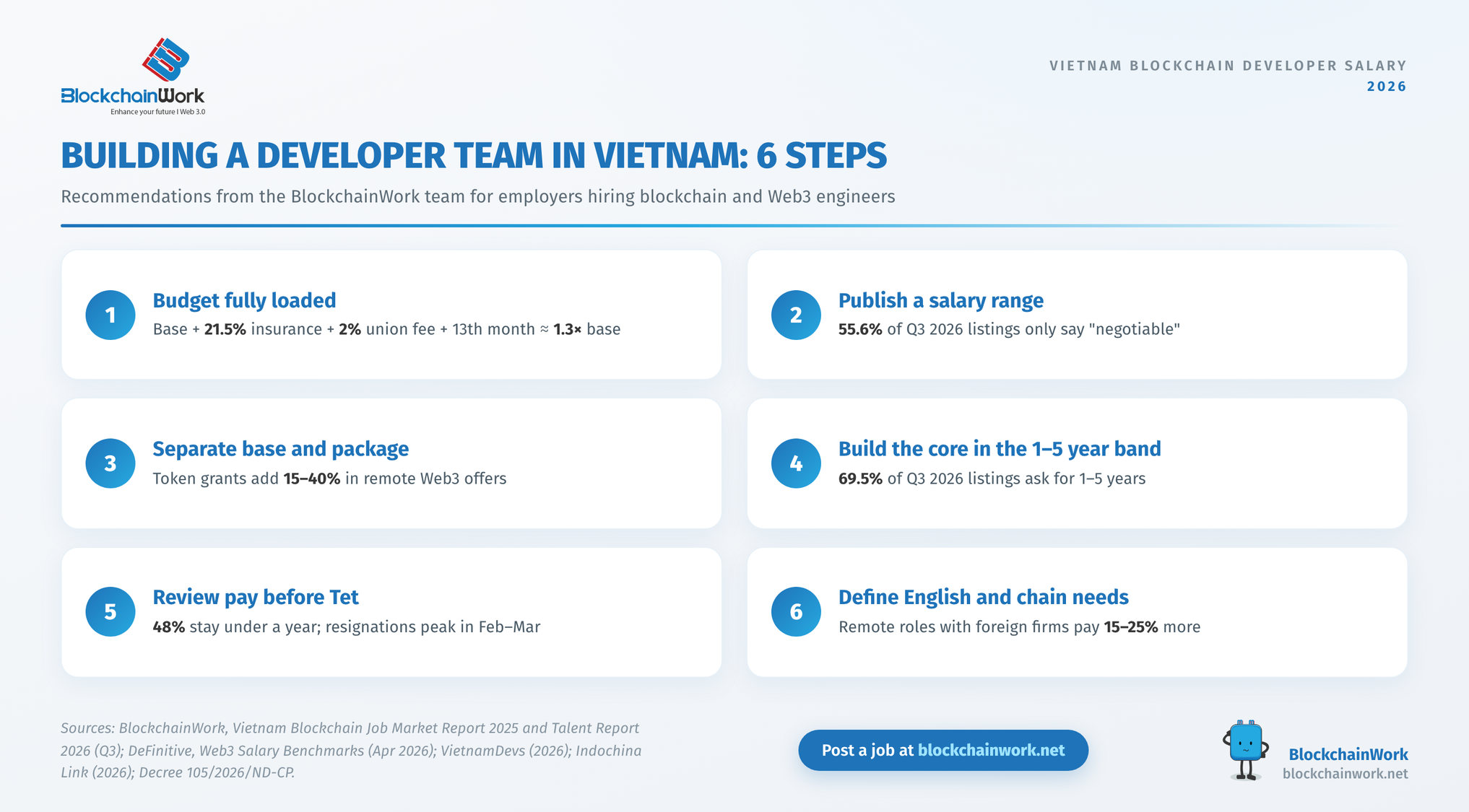
Answer first: budget for the full package rather than the base salary, hire where the market is deepest, and plan retention before the first offer goes out. These are the BlockchainWork team’s recommendations, drawn from the data in this article and from our published reports.
1. Budget fully loaded from day one. Plan every engineering seat at base salary plus 21.5% in employer insurance contributions, the 2% trade union fee and a 13th month. On the VND 30 million benchmark that is about VND 39.55 million a month, or roughly 1.3 times base, before allowances, bonuses and any token component. A plan built on base salary alone misses about VND 9.5 million per engineer every month.
2. Publish a salary range in your job post. In Q3 2026, 55.6% of listings on BlockchainWork’s job board marked salary as negotiable. A stated range, even a wide one, sets your post apart from the majority and filters out candidates whose expectations are far from your budget before the first interview.
3. Separate base and package in every offer. Write base salary, allowances, the 13th month, performance bonus and any token grant as separate lines. Your candidate is likely comparing you with remote international offers, where token grants typically add 15–40% on top of base (DeFinitive, April 2026); a single cash figure makes your offer look smaller than it is.
4. Build the core team in the 1–5 year band. 69.5% of Q3 2026 listings asked for 1–5 years of experience, so that is where the supply of candidates and the competing offers are concentrated. Pair mid-level hires with one experienced lead for architecture and security review, and budget for skill development: 66% of blockchain professionals in our 2025 survey named it as a reason to change jobs, second only to salary (68%).
5. Schedule reviews before Tet, not after. With 48% of candidates staying under one year at each company and resignations clustering in February and March, put salary reviews, bonus decisions and planned promotions in the fourth quarter, before the Tet bonus is paid.
6. Decide early what English and chain experience the role really needs. Remote roles with foreign companies pay 15–25% more than equivalent local roles (VietnamDevs, 2026), and Golang and Rust roles carry a premium over JavaScript (BlockchainWork, 2026). If the role needs working English or production experience on your chain, budget toward the top of the range; if it does not, say so in the post and widen the pool.
When you are ready to hire, you can post the role on blockchainwork.net to reach candidates already working in blockchain and Web3, add a HOT boost to feature the listing on the homepage and BlockchainWork’s channels, or ask our team about headhunting for senior roles that are hard to fill.
How should you use these benchmarks?
Treat the VND 30 million figure as the midpoint of a mid-level engineering hire, not as a target price. Build your plan as: base at benchmark for the seniority you actually need, plus 21.5% in employer insurance contributions and the 2% trade union fee, plus a thirteenth month, plus a variable component if you want to compete with remote international offers for the same candidate. Then decide where in the negotiable range your English and chain-specificity requirements put you.
If you are still choosing between setting up your own entity, renting a development team or hiring through an Employer of Record, see Build, Rent or Hire a Blockchain Team in Vietnam (2026). For the full picture on talent pool size, hiring models, labour law and process, see our pillar guide: Hire Blockchain Developers in Vietnam: 2026 Employer Guide.
BlockchainWork is a specialised blockchain recruitment platform in Vietnam with 25,000+ registered candidates, 12+ educational institution MOUs and 350+ hiring companies. Create an employer account at blockchainwork.net/employer-signup to post roles and reach candidates already working in blockchain and Web3, or contact our team (contact@blockchainwork.net) to discuss what a realistic package looks like for the roles you are planning. For ongoing market data, follow BlockchainWork Insider.
Frequently asked questions
1. What is the average blockchain developer salary in Vietnam in 2026?
BlockchainWork’s 2025 market data, drawn from 1,029 blockchain job listings, puts the average base salary for technical roles with 3+ years’ experience at around VND 30 million per month (roughly USD 1,150), and non-technical roles at around VND 25 million. These are gross base salaries: allowances, bonuses, the 13th-month payment, token grants and employer contributions sit on top.
2. How much cheaper is Vietnam than hiring a Solidity developer in the US or Europe?
On base salary the difference is roughly an order of magnitude: a Vietnamese engineer at the VND 30 million benchmark is on about USD 13,800 per year, against a US average base of USD 175,000 for Solidity developers and a US Tier 1 developer range of USD 140,000–260,000 (DeFinitive, April 2026). Fully loaded cost narrows that gap somewhat, and senior Vietnamese engineers with strong English are reachable by remote international offers, so the local benchmark is not a ceiling on what your candidate can earn.
3. What are the employer costs on top of salary in Vietnam?
Mandatory employer contributions total 21.5% of the contribution base for Vietnamese employees (17.5% social, 3% health, 1% unemployment) and 20.5% for foreign employees, who are outside unemployment insurance. Social and health insurance are capped at a base of VND 50,600,000 per month from 1 July 2026 (VND 46,800,000 before that date). Separately, employers pay a 2% trade union fee on the same social insurance payroll, even if the company has no grassroots trade union (Trade Union Law No. 50/2024/QH15, Article 29). Most tech employers also pay a 13th-month or Tet bonus, which is contractual rather than statutory but effectively expected in the tech market.
4. Why do so many Vietnamese blockchain job ads not show a salary?
Because 56% of the blockchain listings analysed for 2025 marked salary as negotiable (BlockchainWork, 2026), and the share was 55.6% on BlockchainWork’s job board in Q3 2026. In a market where the specialised talent pool is small, employers price candidate by candidate rather than publishing a band. Expect to benchmark against comparable offers rather than against advertised ranges.
5. Which skills raise a blockchain engineer’s salary most in Vietnam?
Four factors: production experience on the specific chain you use; working English, which opens remote roles with foreign companies that pay 15–25% above equivalent local roles (VietnamDevs, 2026); location, with Hanoi and Ho Chi Minh City carrying the highest benchmarks; and audit or security exposure on a live protocol. Golang and Rust roles also carry a premium over the most widely recruited language, JavaScript (BlockchainWork, 2026).
Sources
- BlockchainWork, Vietnam Blockchain Job Market Report 2025 – Outlook for 2026 (2026)
- BlockchainWork, Vietnam Blockchain Talent Report 2026: Q3 Job Market Trends (2026)
- ITviec, IT Salary & Recruitment Market Report 2025-2026 (2025) – general IT developer data
- DeFinitive, Web3 Salary Benchmarks (updated April 2026)
- Indochina Link, Vietnam Social Insurance 2026: Compliance Guide for FDI Enterprises (2026)
- National Assembly of Vietnam, Trade Union Law No. 50/2024/QH15, Article 29, as amended by Law No. 97/2025/QH15 (consolidated text 90/VBHN-VPQH, 2025)
- Government of Vietnam, Decree No. 105/2026/ND-CP on trade union finance (31 March 2026, in force 16 May 2026)
- VnEconomy, report on social insurance contributions under the new base salary from 1 July 2026 (June 2026)
- VietnamDevs, Vietnam Software Developer Salaries: 2026 Guide for International Recruiters (2026)
- Vietcombank, foreign exchange rates (5 November 2026)
BlockchainWork
** This content does not constitute investment advice, investment strategy recommendations, or sponsored advertising. Please refer to our Disclaimer and use the information at your own discretion.
BlockchainWork – Vietnam’s leading blockchain talent community, connecting passionate candidates with pioneering companies in blockchain and Web3. With 25,000+ registered candidates, 12+ educational institution MOUs and 350+ hiring companies, BlockchainWork is the specialized platform for blockchain careers, from Vietnam to global opportunities.
- Partnership inquiries: contact@blockchainwork.net
- Learn more: blockchainwork.net
- Latest blockchain jobs: blockchainwork.net/viec-lam-moi-nhat
- Employers, connect with top talent: blockchainwork.net/employer-signup
- Candidates, find your next opportunity: blockchainwork.net/candidate-signup
- Join the community: Vietnam Blockchain Community – BlockchainWork
>> You may also like:
- Vietnam Blockchain Talent Report 2026: Q3 Job Market Trends
- Why Japanese Firms Hire Vietnamese Engineers (2026 Data)
- Build, Rent or Hire a Blockchain Team in Vietnam (2026)
- Hire Blockchain Developers in Vietnam: 2026 Employer Guide
- BlockchainWork releases Vietnam Blockchain Job Market Report 2025 – Outlook for 2026
- 10 Smart Contract Audit Tools Compared (2026)

Vietnam Blockchain Talent Report 2026: Q3 Job Market Trends
Vietnam's blockchain job market in Q3 2026 versus Q2: roles, cities, experience levels, salary signals and what candidates should prepare in the AI era.

BlockchainWork Releases Vietnam Blockchain Job Market Report 2025 – Outlook for 2026
After years of rapid experimentation shaped by the volatility of the global crypto market, the blockchain industry in Vietnam is entering a new phase. By 2025, the sector is gradually transitioning toward a more structured ecosystem, with improving…

June 2025 Blockchain Jobs in Vietnam: Trends and Insights
The June 2025 Blockchain Jobs in Vietnam market has entered a new phase of stability and strategic filtering after months of fast-paced growth. Instead of merely expanding headcounts, blockchain companies are now focusing on strategic, high-skilled hires, particularly…

May 2025 Blockchain Jobs in Vietnam: Trends and Insights
In May 2025, the blockchain job market in Vietnam continues its steady growth, reflecting increasing interest from both domestic and international companies. The number of job openings in the industry continues to rise compared to the previous month,…

April 2025 Blockchain Jobs in Vietnam: Trends and Insights
The April 2025 blockchain jobs in Vietnam continues to experience significant and steady growth, with a notable increase in job opportunities compared to the previous month. While non-tech jobs still dominate, tech roles continue to play a crucial…




Blockchain - Web3 jobs


